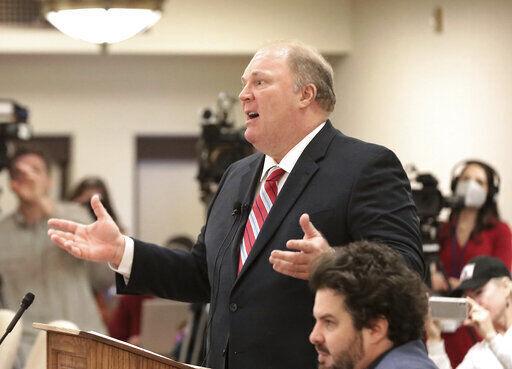
Assembly Speaker Robin Vos has again been ordered by a Dane County judge to produce requested public records related to a taxpayer-funded partisan probe of the 2020 election by former state Supreme Court Justice Michael Gableman.
Circuit Judge Valerie Bailey-Rihn on Friday issued the decision, which also orders Vos, R-Rochester, to pay statutory fees and attorney fees to liberal watchdog group American Oversight, which filed the lawsuit following multiple open records requests related to the election probe being conducted by Gableman.
In the order, Bailey-Rihn wrote that Vos provided no evidence to explain why it took six months for him to respond to some of American Oversight’s records requests, despite state law requiring an authority to respond “as soon as practicable and without delay.” In addition, when Vos did respond, he produced 1,400 pages of records from an unwanted time period, Bailey-Rihn noted.
People are also reading…
“Based on the undisputed evidence of Vos’ ineffectual records practices, I can draw no reasonable inference except that Vos did not search for records in the first instance,” Bailey-Rihn wrote.
Vos has 20 days to search for and produce records related to American Oversight’s requests, per the judge’s order. Bailey-Rihn also denied American Oversight’s motion for punitive damages against Vos.
“In sum, ‘that (Vos) was wrong does not justify punitive damages,’” Bailey-Rihn wrote. “Here, the records could still exist and be produced if they were properly searched for by the Respondent.”
Vos’ office had not responded to a request for comment Friday.
Bailey-Rihn ruled last month that Vos would not be penalized for a previous contempt order related to the case, but said she would decide later if Vos should face penalties related to how his office handled requests for records related to Gableman’s review.
A status conference has been scheduled on the matter for July 21.
American Oversight has filed four lawsuits against Gableman, Vos and the state Assembly related to the GOP-ordered review of the 2020 election.
“It’s ironic that Vos claimed an investigation was necessary to instill confidence in the election outcome, but then has done everything in his power to prevent Wisconsinites from learning the whole truth,” American Oversight senior adviser Melanie Sloan said in a statement Friday. “Vos is not above the law and American Oversight is gratified to see him held accountable for violating Wisconsin’s public records law.”
Dane County Circuit Judge Frank Remington last month held Gableman’s office in contempt, offering a scathing rebuke of the former justice’s behavior in court a week earlier, when Gableman accused the judge of being a partisan “advocate.”
Remington ultimately held Gableman’s office in contempt for failing to adequately respond to the requests and ordered Gableman be fined $2,000 a day until he complies. He also directed Gableman’s “sneering” conduct in Remington’s courtroom to the office that regulates attorneys and judges in Wisconsin to take possible action against his license to practice law.
Gableman has appealed the ruling and is seeking a review by a three-judge panel in Wisconsin’s District 2 Court of Appeals in Waukesha.

Gableman was hired by Vos under pressure from Donald Trump to review the election the former president lost to President Joe Biden by about 21,000 votes in Wisconsin. While the probe was originally allocated $676,000 in taxpayer funds, invoices have shown that ongoing court battles surrounding the review have pushed the cost to more than $900,000.
Vos earlier this year paused Gableman’s probe to allow time for pending lawsuits related to the review to play out in court and halved Gableman’s monthly salary from $11,000 to $5,500.
A recount, court decisions and multiple reviews have affirmed that Biden defeated Trump in Wisconsin. Only 24 people out of nearly 3.3 million who cast ballots have been charged with election fraud in Wisconsin.
The 2020 election is over. Here’s what happened (and what didn’t)
The 2020 election was “the most secure in American history,” according to the Department of Homeland Security’s Cybersecurity and Infrastructure Security Agency, which coordinates the nation’s election infrastructure.
While a handful of voters risked going to prison by attempting to vote twice or in the name of a dead relative, as happens in any election, no evidence of widespread fraud has ever been produced in Wisconsin or elsewhere.
Yet, many continue to question some of the practices clerks relied on to encourage eligible voters to cast ballots and make sure their votes were counted amid the first election in more than 100 years held during a pandemic.
The Wisconsin State Journal has covered every twist and turn of this debate in scores of stories. But here are a few that offered some broader context about what happened, and didn’t happen, in the election of 2020.


The Associated Press reviewed every potential case of voter fraud in six battleground states — Arizona, Georgia, Michigan, Nevada, Pennsylvan…