Secretary of State Jocelyn Benson asked the GOP-led Legislature Tuesday for an extra $100 million to distribute to county and municipal clerks after criticizing lawmakers for passing bills she said are in “search of nonexistent problems.”
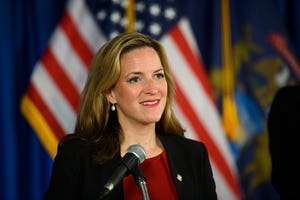
The annual allotment would be used for election administration and security and should be in place ahead of the November general election, Benson told media.
“It’s time for our Legislature to put its money where its mouth is and provide consistent and sufficient funding to ensure our elections are safe and secure,” Benson said.
“For too long, our state Legislature has relied on local governments and federal agencies to keep our elections secure, accessible and funded, oftentimes resulting in unpredictable and insufficient funds.”
The funding demand and three other policy requests the Detroit Democrat outlined in a Tuesday press conference come in the wake of repeated vetoes by Gov. Gretchen Whitmer of election legislation passed by the GOP-led Legislature.
The Legislature’s bills have sought to tighten signature and ID requirements for absentee and in-person voting as well as prevent fraudulent statements on absentee applications.
Whitmer has criticized the bills as having a chilling effect on voters, and Benson on Tuesday said the policies spread misinformation that was rampant after the November 2020 election and were “in search of nonexistent problems.”
“It is time for our allies and teammates, I hope, in the Legislature to do the people’s work and pass nonpartisan election policies that serve all voters on both sides of the aisle,” Benson said.
State Rep. Ann Bollin countered Benson’s critique of the Legislature’s election policy so far, noting successful bills have focused on issues such as voter ID, election challenger and inspector training, signature verification training and processes for removing dead or inactive voters from the state qualified voter file.
Bollin, the Brighton Township Republican who chairs the House Elections Committee, said she has proposed $10 million for operations grants for local clerks as well as a $10 million reserve fund for the state’s eventual replacement of voting equipment.
She also argued that the secretary had federal money available to help with local elections.
“We have had several elections since November 2020 and I haven’t heard that there is a great gap in security from the secretary,” Bollin said. “I would really like to know what the justification is for this $100 million.”
Benson also asked the Legislature to develop and pass policies allowing clerks to count absentee ballots up to seven days ahead of the election so that residents don’t have to wait for results.
“They need to give voters results on election night,” Benson said. “This is the proposal that will enable that to happen.”
Michigan saw record absentee voter participation in the November 2020 election, in part because Benson sent unsolicited absentee ballot applications to every voter on the state’s qualified voter file. The secretary said she doesn’t plan to do the same mailing ahead of the November gubernatorial election because circumstances have changed between 2020 and 2022.
Benson said a large motivator in the 2020 election for sending out the applications was the pandemic and the fact that November 2020 marked the first federal or general election after Michigan’s passage of no-reason absentee voting in 2018.
Bollin said she doesn’t expect the effect of the 2018 passage of no-reason absentee voting to be as drastic as it was in 2020.
“I don’t think we should plan every election based on the November 2020 election,” Bollin said.
Benson also requested Tuesday that the Legislature develop laws with specific bans against threatening, harassing or doxing election administrators, a measure opponents say is already in place through generalized laws against harassment or intimidation.
The secretary on Tuesday pushed for the Legislature to allow for the electronic return of absentee ballots from military members and their families who are stationed overseas.
Benson said about 25% of military ballots — about 1,600 — arrived too late to be counted in the November 2020 election. She noted the House and Senate passed similar legislation ahead of the November 2020 election only to later vacate its enrollment before it could be sent to the governor for her signature.
“I’m asking now, on behalf of all military service members and their spouses serving overseas, that lawmakers pass this again and this time ensure it is delivered to the governor for her signature,” Benson said.
Bollin noted there is a bill moving through the Legislature that would allow overseas military members to electronically return their ballots, but it stops short of allowing their family members to do the same.