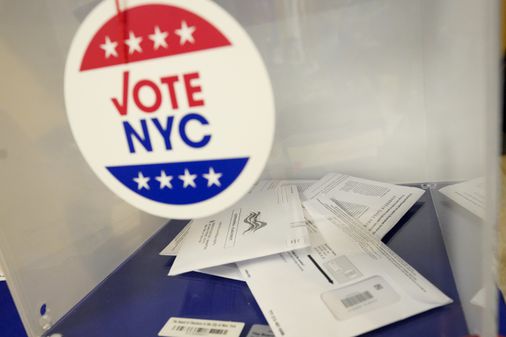
NEW YORK — More than 800,000 noncitizens and “Dreamers” in New York City will have access to the ballot box — and could vote in municipal elections as early as next year — after Mayor Eric Adams allowed legislation to automatically become law Sunday.
Opponents have vowed to challenge the new law, which the City Council approved a month ago. Unless a judge halts its implementation, New York City is the first major US city to grant widespread municipal voting rights to noncitizens.
More than a dozen communities across the United States already allow noncitizens to cast ballots in local elections, including 11 towns in Maryland and two in Vermont.
Noncitizens still wouldn’t be able to vote for president or members of Congress in federal races or in the state elections that pick the governor, judges, and legislators.
The Board of Elections must now begin drawing an implementation plan by July, including voter registration rules and provisions that would create separate ballots for municipal races to prevent noncitizens from casting ballots in federal and state contests.
It’s a watershed moment for the nation’s most populous city, where legally documented, voting-age noncitizens comprise nearly one in nine of the city’s 7 million voting-age inhabitants. The movement to win voting rights for noncitizens prevailed after numerous setbacks.
The measure would allow noncitizens who have been lawful permanent residents of the city for at least 30 days, as well as those authorized to work in the United States, including “Dreamers,” to help select the city’s mayor, City Council members, borough presidents, comptroller, and public advocate.
“Dreamers” are young immigrants brought to the country illegally as children who would benefit from the never-passed DREAM Act or the Deferred Action for Childhood Arrivals program, which allows them to remain in the country if they meet certain criteria.
The first elections in which noncitizens would be allowed to vote are in 2023.
“We build a stronger democracy when we include the voices of immigrants,” said former city councilor Ydanis Rodriguez, who led the charge to win approval for the legislation.
Associated Press
Biden shied away from press conferences in first year
WASHINGTON — In what’s become a familiar scene, President Biden lingered after delivering a recent speech on the pandemic as reporters fired a barrage of questions.
He bristled at a query about the shortage of COVID-19 rapid tests, answered another about Omicron-spurred travel restrictions, and sidestepped a third about whether Senator Joe Manchin failed to keep his word when he torpedoed Biden’s social services and climate spending plan.
”I’m not supposed to be having this press conference right now,” Biden said at the end of a meandering response that didn’t directly answer the question about Manchin. Seconds later, Biden turned and walked out of the State Dining Room, abruptly ending what’s become his preferred method for his limited engagements with the press.
As Biden wraps up his first year in the White House, he has held fewer news conferences than any of his five immediate predecessors at the same point in their presidencies and has participated in fewer media interviews than any of his recent predecessors. The dynamic has the White House facing questions about whether Biden, who vowed to have the most transparent administration in the nation’s history, is falling short in pulling back the curtain on how his administration operates and missing opportunities to explain his agenda.
Biden does more frequently field questions at public appearances than any of his recent predecessors, according to new research published by Martha Joynt Kumar, a professor emerita in political science at Towson University and director of the White House Transition Project. He routinely pauses to talk to reporters who shout questions over Marine One’s whirring propellers as he comes and goes from the White House. He parries with journalists at Oval Office photo ops and other events. But these exchanges have their limitations.
”While President Biden has taken questions more often at his events than his predecessors, he spends less time doing so,” Kumar notes. “He provides short answers with few follow-ups when he takes questions at the end of a previously scheduled speech.”
Biden has done just 22 media interviews, fewer than any of his six most recent White House predecessors at the same point in their presidencies. The 46th president has held just nine formal news conferences — six solo and three jointly with visiting foreign leaders. Ronald Reagan, whose schedule was scaled back early in his first term in 1981 after an assassination attempt, is the only recent president to hold fewer first-year news conferences, according to Kumar. Reagan did 59 interviews in 1981.
Associated Press
Ron Johnson will seek reelection
WASHINGTON — Senator Ron Johnson, the Wisconsin Republican who over the last year has become the Senate’s leading purveyor of misinformation about elections and the coronavirus pandemic, announced Sunday that he would seek reelection to a third term.
Johnson, 66, had pledged to step aside after two terms but opened the door to a third shortly before the 2020 presidential election.
His entry into the race is certain to focus enormous attention on Wisconsin, a narrowly divided political battleground where Governor Tony Evers, a Democrat, faces a difficult reelection bid in a race that may determine control of the state’s election systems ahead of the 2024 presidential contest.
“Today, I am announcing I will continue to fight for freedom in the public realm by running for reelection,” Johnson wrote in an essay published Sunday in The Wall Street Journal.
Johnson’s decision follows an announcement Saturday from another Senate Republican weighing retirement, Senator John Thune of South Dakota, that he would seek a fourth term.
The Wisconsin Senate contest is expected to be among the tightest in the country. Johnson is loathed by Democrats and has attracted a double-digit field of challengers vying to take him on in the general election.
When Johnson first entered politics in 2010 as a self-funding chief executive of a plastics company founded by his wife’s family, he defined himself as a citizen legislator in contrast with Senator Russ Feingold, a Democrat who had been in public office for 28 years. Johnson was carried into office by that year’s Tea Party wave, then beat Feingold again in 2016 as Donald Trump became the first Republican presidential nominee to win Wisconsin in 32 years.
All along, Johnson pledged to serve no more than 12 years in the Senate, but he began to privately reconsider after the 2018 elections when Democrats took back control of the House of Representatives and won narrow victories in Wisconsin’s statewide elections. He wrote Sunday that when he reiterated his two-term pledge during his 2016 race he didn’t anticipate “the Democrats’ complete takeover of government and the disastrous policies they have already inflicted on America and the world.”
New York Times